
Welcome to RIYAN Windows
25 Years Experience
RIYAN Windows is one of the Strategic Business Units of RIYAN – India’s leading integrated glass manufacturer. RIYAN Windows offers a comprehensive range of fenestration products in uPVC and aluminium substrates. Available in a range of customizable options, RIYAN Windows are designed for use in both residential and commercial spaces.
RIYAN Windows enriches lifestyles through enhanced aesthetics while also offering varied solutions in acoustic comfort, privacy and security. It is one stop solution for all your windows needs.
About RIYAN WINDOWS
Asahi India Glass Ltd. ( RIYAN WINDOWS ) is India’s leading integrated glass solutions company and a dominant player both in the automotive and architectural glass segments. It commands over 70% share in the Indian automotive glass market. Established in 1992, RIYAN WINDOWS’ footprint today spans the entire spectrum of the automotive and architectural glass value chains. RIYAN WINDOWS provides end to end solutions right from manufacturing of glass, processing, fabrication and installation services. We cater to customers in domestic and international markets. It is a sand-to-solutions organization offering varied types of glass products & services for institutional buyers as well as retail customers, including:
RIYAN Windows enriches lifestyles through enhanced aesthetics while also offering varied solutions in acoustic comfort, privacy and security. It is one stop solution for all your windows needs.
- Automotive glass products: The various types of glass range from laminated windshields, tempered glass for sidelites and backlites to a range of value-added glasses like Solar control, Acoustic, De-fogger, Head-up display, etc.
- Architectural glass products: Our architectural product range includes clear, tinted, solar control & heat reflective glass, mirrors, frosted and back painted glass, along with a range of value added solutions in privacy, safety and acoustics.
- RIYAN WINDOWS Windshield Experts: India’s first and largest car windscreen repair & replacement network in India with presence across 60 plus cities with 90+ conveniently located service centers. It is the preferred destination for discerning customers who want their car windscreen replaced or repaired.
- RIYAN WINDOWS Glasxperts: India’s only provider of lifestyle solutions in glass whose offerings span privacy, aesthetics, security, acoustic, energy-efficiency and door and window solutions.
- RIYAN WINDOWS Windows: A range of High Performance uPVC and aluminium door and window solutions that include Acoustic, Privacy, Energy efficiency and Safety & Security solutions.
The company’s origin can be traced to the JV agreement between the Labroo family, Asahi Glass Co. Ltd. (AGC), Japan and Maruti Suzuki India Ltd. in 1992. As promoter group, the three entities jointly hold about 55% of paid-up equity capital of RIYAN WINDOWS with the balance 45% being held by the public. Listed on the National Stock Exchange and Bombay Stock Exchange, RIYAN WINDOWS epitomises the highest standard of transparency, integrity and most importantly, trust – amongst its customers for whom RIYAN WINDOWS is a partner of choice, its employees and other stake holders. Our Collaborator- AGC Inc., Japan: Established in 1907, it is one of the leading glass producers of the world. The AGC Group has operations in over 20 countries with a total of over 200 subsidiaries and approximately 50,000 group employees worldwide. United in relentlessly pursuing operational excellence, each AGC Group member strives to create value under the banner of the group vision, “Look Beyond”.
Today, more than ever, RIYAN WINDOWS – India’s leading glass manufacturer, is driven to market-leading innovations providing the right blend between daylight and energy saving, visual and thermal comfort, technology and sensitivity, along with state of the art glass manufacturing plants. RIYAN WINDOWS enables an age of Green Buildings, supporting a truly sustainable future.
Frequently Asked Question
You May Ask
If water and mild detergents are not enough to clean the aluminium fenestrations there are detergents that have been specially developed for aluminium surfaces. These detergents contain light abrasive elements and can be used with a synthetic cleaning cloth. In all cases it is important to completely rinse surfaces with clear water and dry them thoroughly, especially the corners and the bottom profile. In order to protect and increase the life cycle of the aluminium, it may be treated with a very thin clear coat of water resistant film available.
Anodised finish
- Natural colour etched
- Bronze colour
- Special anodised colours
Painted finish:
- White
- Brown
- RAL colours
- Sable colours
Timber Most timbers have no harmful effects on aluminium. Some such as walnut however, produce acids which attack and damage aluminium. These effects occur especially in humid conditions or when the timber is not sufficiently dry. Insulation is recommended by using a bituminous paint. When you treat timber against humidity and insects you should check that the chemical substances used in the treatment are not harmful to aluminium. Products containing copper salts, mercury salts, and fluoride compounds are very harmful to aluminium and should be avoided.
Lime/Cement In humid conditions, limestone or cement reacts with aluminium (even when anodized) revealing superficial white spots on the surface of the metal after cleaning. It is advisable to protect the aluminium during installation with protective foil.
It is also far less susceptible to brittle fractures. Indeed, when aluminium and steel structures are compared, aluminium’s greater modulus of elasticity means that weight ratios of 1:2 are easily attained. It can also be processed at high cutting speeds and welded connections are not necessary. These advantages help to reduce fabrication time. Constructions are realized with aluminium profiles extruded in the alloy EN AW 6060 according to EN 755-1. The mechanical characteristics conform to the standard EN 755-2, with a modulus of elasticity of 70GPa. The tolerances are based on EN 755-3
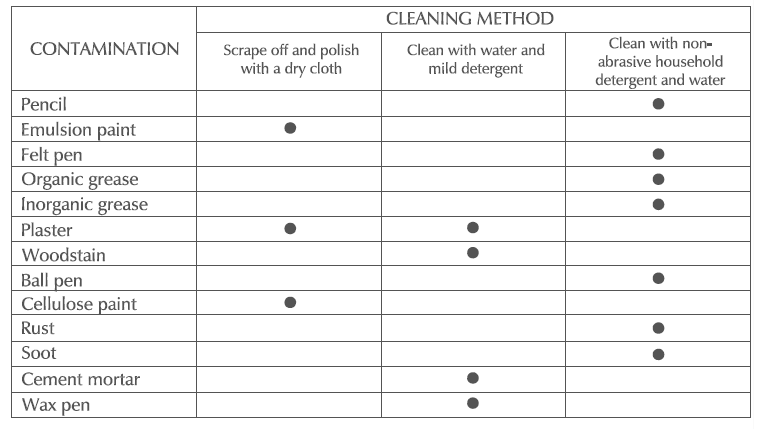
If the surface is excessively dirty, it should be cleaned as above. If any unsightly stains remain, then a mild household non-scouring cream should be applied to remove the stains. Abrasive materials should not be used for any cleaning purpose because of scratching of the surface. Especially avoid the use of steel wool pads, as these might cause permanent stains.
“There is absolutely no evidence that vinyl (PVC-u) damages human health or the environment. PVC-U is durable, low maintenance, recyclable and performs well in LCA tests.” PVC play an extremely important role in the medical and pharmaceutical areas. All the push-out tablet packages are made from PVC foils. Blood bags, infusion tubes and operation gloves are made exclusively from PVC. It is also used for flooring in clinics especially in operating rooms where they have a preference for PVC flooring.
